
Methods
Why VM0047 Matters for ARR
A brief on how this methodology approaches integrity in large-scale ARR.
The VM0047 methodology by Verra, which was made active on 14th May, 2025, changes how large-scale ARR projects are evaluated. Instead of treating the baseline as mostly fixed after project setup, the area-based approach re-tests performance at each verification using a dynamic benchmark. In practice, a project must show that vegetation is improving more than carefully matched control plots outside the project boundary. Area-based projects using the VM0047 must also apply the VMD0054 module for leakage.
The table below simplifies what changed under VM0047’s area-based approach as compared to methodologies establishing fixed baselines.
Topic | Older ARR mindset | VM0047 v1.1 mindset |
|---|---|---|
Baseline | Often treated as mostly fixed at the start | Re-tested through a dynamic performance benchmark |
Evidence | Heavy reliance on project narrative and field sampling | Remote sensing + field plots + matched controls |
Leakage | Often handled more loosely | Standardised leakage accounting through VMD0054 |
What this means in practice is that ARR now has to be MRV-native from day one. Project design, boundary logic, and activity definitions need to match what spatial systems can actually observe. Control selection is no longer an annex-level detail, but rather a central integrity mechanism.
VM0047 requires at least 30 randomly sampled project plots for the representative sample, matched controls selected through k-nearest-neighbour optimal matching without replacement, and match quality that passes a standardised difference-of-means threshold of 0.25 or less for each covariate. It also requires a documented monitoring plan and repeatable procedures.
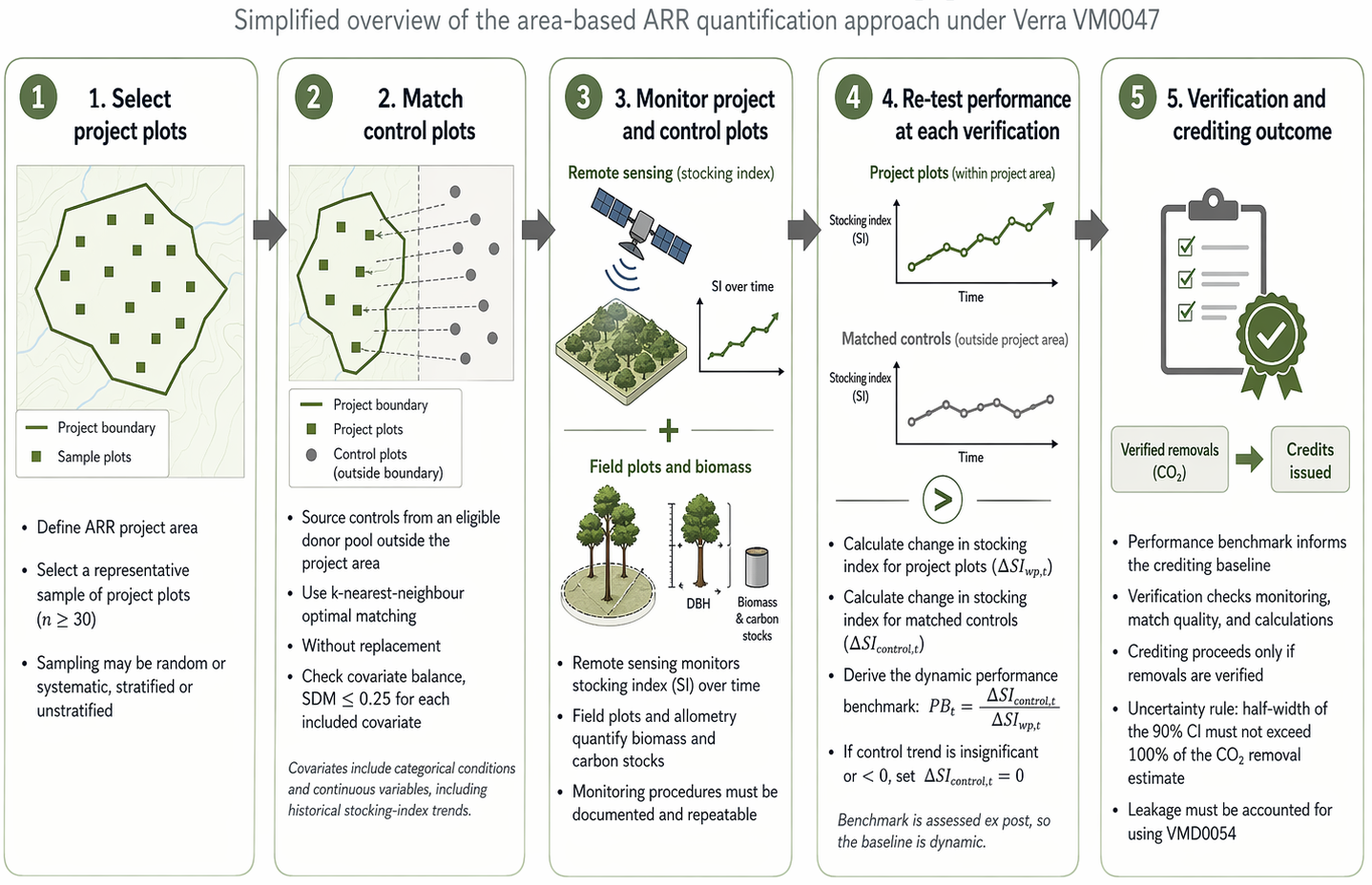
Figure: Overview of the stages involved in VM0047's area-based approach
A common misunderstanding is that VM0047 is satellite-only, when it is not. Verra is explicit that the area-based approach still relies on traditional plot-based sampling to estimate biomass, while remote sensing tracks changes in a stocking index that must correlate with aboveground carbon stocks. This is not the end of fieldwork. It is the start of a tighter relationship between field measurement and spatial monitoring.
The methodology also turns uncertainty into a business issue. A project is not eligible for crediting if the half-width of the two-sided 90% confidence interval exceeds 100% of the carbon dioxide removal estimate. Weak sampling, poor calibration, or messy data management can directly reduce issuable credits.
The market signal is moving in the same direction. ICVCM’s assessment table shows VM0047 v1.0 as CCP-Approved, and Verra’s ABACUS label exists specifically for ARR credits that meet extra quality requirements beyond the methodology minimum. At the same time, ICVCM has noted that the approach is novel, that further empirical testing may reveal new risks, and that remote sensing can become less informative once full canopy cover is reached.
On 20th April, 2026, Verra approved the first credits globally under VM0047, with the Brazil Cerrado 1 project - ID 5511, eligible to issue 230,120 VCUs under v1.0 of the methodology. The project is located across Mato Grosso do Sul, Mato Grosso, and Minas Gerais in Brazil, and is registered under both Verra’s Verified Carbon Standard and Climate, Community & Biodiversity Standards programs.